ARBITER DRES LLIVIA THIRALAS
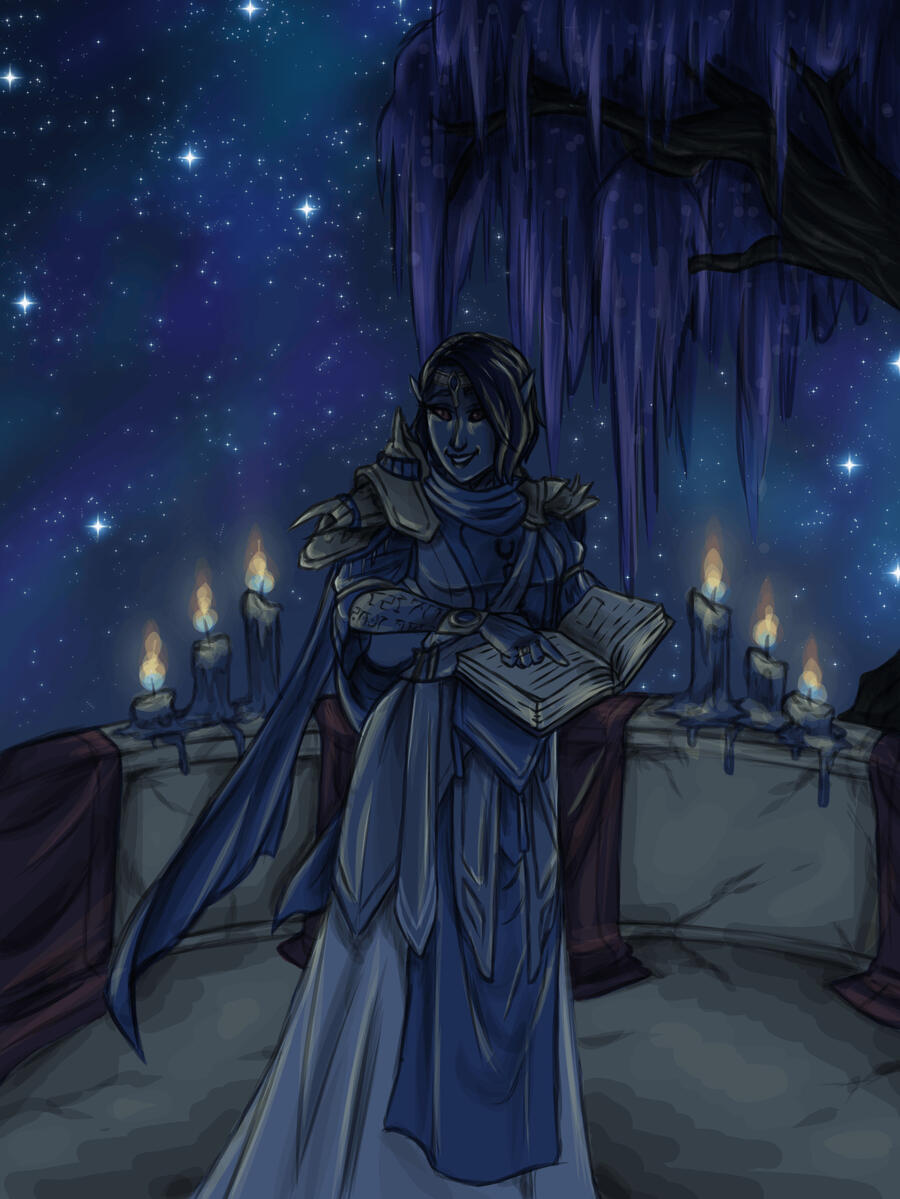
Llivia Thiralas reference art
Click to reveal (artistic nudity)
Pictured above is Llivia circa 2E 593 by the talented @spinchmuth on Discord.

Name: Dres Llivia Thiralas

Age: 121 (as of 2E 593)

Height: 1.85m / 6’1”

Build: Tall, powerful, elegant. The poise of law and measured patience, trained to strike when duty demands.

Hair: Moon-silver, to the small of her back

Eyes: Left - Crimson; Right - blind, milky opal white

Notable Features: Brass prosthetic left arm, Tribunal and Sehtist scripture tattoos, storied marring across her figure.

An Excerpt on Arbiter Thiralas
Great House Dres Public Record Summary, Order of Doctrine, Tear

Known throughout House Dres lands as a gifted healer and formidable sermonizer of the teachings of Seht, Arbiter Dres Llivia Thiralas has served the Tribunal Temple and the Great House Dres for decades. In her years, she has borne many titles; Almsti (Priestess), Sedura (Lady/Noble), Ponihn (Councilor), Kena (Teacher/Scholar), Arihn'Almsti (Inquisitor), and now Amalata (Arbiter/Judge), guiding all of ALMSIVI's children through seasons of strife and quiet restoration alike. She administers rites, tends the wounded, delivers judgements, and settles disputes where diplomacy fails.


Llivia is mother to Dres Darion Thiralas, a child of seven years (as of 2E 593), and has been wed multiple times over her years.

Tattoos

Her skin is freckled ash-gray, marked by decades of devotion.

  • Arms & Ribs: Verses from Tribunal scripture and tomes coil like living sermon.
  • Hands: Seht's Torch & Cog guiding every holy touch.
  • Midriff: Azura’s Moon-and-Star encircles her navel.
  • Back: The Hand of ALMSIVI, centered and absolute.
  • Right Thigh: The Crest of House Thiralas, chains entwined in blooming rose vines.
  • Left Thigh: Seht’s ever-turning gears fed by thorned devotion.
Prosthetic Arm

Where flesh once lived, now brass gleams, refined clockwork fused to scar.

Her left arm is detachable, inscribed with the scripture that once adorned living skin.

Inside the wristplate, visible only to those she lets see it:

“High Captain of the Watch
Alynas Ulessen.
Sister. Savior. Shield.”
Scars
  • Lip: A split scar on the upper right from a former husband whose name earns no breath.
  • Shoulder: Smoldering burns, raw and angry, fused beneath the brass cap of her prosthetic shoulder.
  • Left Calf: A healer’s hesitation in the heat of battle. A clean strike long since healed and faded.
  • Midriff: A brutal puncture near the navel, jagged and wild, clearly cauterized first, and later healed properly.
BACKSTORY

“Yi hilyed khosid po'tosh ae aln'muhr khis...
Ae Nammu yi yaglad... difshid ae mer.
Amuhr norid AlmSiVi Yi fredad.”

I wait to walk beyond the waiting door.
As a no-name I will come to rest among my kin.
Alive through faith I will protect.

I. UNDER THE FIRST MOTHER'S GAZE
2E 472–2E 491 // Azura’s Coast → Tear

Llivia Thiralas was born on the 21st of First Seed 2E 472 under the Lord’s watching constellation, in a villa along the mist-rolled Azura’s Coast. Her mother, Dinaesi, nearly died birthing her, leaving both of them tethered to the edge of the waiting door before stumbling back into life. The family called it Ayem’s mercy. Llivia later learned it was Azura’s promise.


Raised among wealth but not affection, Llivia sought the nurturing love her parents seldom offered from those who lived and worked beneath House Thiralas. Chief among them were the children of household retainers, Marase, Navam, and their oldest sister Alynas Ulessen. Alynas and Llivia were born mere months apart, and though class forbade their closeness, it only made them cleverer in finding each other. The four children roamed saltrice fields and ancestor gardens like a single unruly pack. Llivia helped raise the younger ones like they were her own; she learned responsibility not from her noble tutors or studies, but from being needed.


Her uncle Rindral Berendil stoked her curiosity for the world, for scripture, law, the spear, and the unshakable faith that purpose was earned, not granted. She learned blade and sermon in equal measure; chitin and scripture shaped her bones. She cherished the Homilies of Blessed Almalexia and learned to pray before she learned to write. While her days were filled with tutors and studies, her nights belonged to the stars, and somewhere between prayer and astronomy she began to whisper thanks to the twilight, believing the night heard her better than the day.

“The faithful child feeds the roots that elders forget.” — Dunmeri saying
II. THE FIRST CIRCLE BROKEN
2E 491–2E 504 // The Drilvi Estate, Tear, The Upper Cantons

At nineteen, Llivia’s destiny was sold for kwama veins and a ledger full of promises not her own. Her father traded his only daughter into marriage with Dres Tiras Drilvi, a plantation master more than twice her age and half her kindness. Alynas Ulessen, now a sworn acolyte of the Temple, and once her constant childhood shadow, stood among the Ordinators observing the ceremony. The salute she gave Llivia felt less like honor and more like a goodbye.


The marriage was gilded captivity; silk robes and suffocating expectations. Llivia’s world condensed into the upper cantons of Tear, high above the ash and salt but never further from freedom. When she could flee, she fled to the Abbey of Saint Llothis, to the turning gears of Seht, the certainty of doctrine, and the dream that knowledge could fracture chains. For eleven years she endured the price of obedience. When she finally conceived, hope fluttered; fragile, terrified. Dres Tovas Drilvi was born in Second Seed, 2E 503. But scarcely had she learned to love her child before the plague took root in Tiras’ mind. Delirium twisted affection into delusion. He accused her of poisoning him, of sabotaging his estate, while in truth Avron Thiralas, her own father, was quietly draining the Drilvi coffers to dryness to fund his next folly.


The Ordinators arrived to investigate the accusations. Llivia expected chains. But one helm came off, and Alynas stood before her. Her crimson eyes narrowed; not in suspicion, but fury on her behalf.

“If this mer is wronged, I will restore him.
If she is wronged, I will break those who doubt her.”
— Captain Alynas Ulessen

Protocol demanded interrogation. Alynas offered protection. Tiras’ accusations were dismissed mere days before death claimed him. Llivia stood at his funeral pyre with a child in her arms and no future in her grasp. Terrified that grief, poverty, and ignorance would make her a danger to her newborn son, she relinquished little Darion to the surviving Drilvi kin. Alynas did not comfort her. She simply stayed, sword-silent, watching over her as if daring the world to try again.


Through this Llivia learned two truths that would shape her forever: Houses will sacrifice daughters before wealth. Alynas would sacrifice anything before Llivia. Faith, loss, and duty braided themselves into resolve. And beneath her quiet obedience, a new fire began to burn.

“Love is a labor. Protection is a promise.”Homilies of Blessed Almalexia
III. ASHES OF THE THIRALAS
2E 505–2E 509 // The Thiralas Estate, Tear, The Lower Cantons

Summoned home by duty, Llivia found both parents dying of the same plague that had taken her husband. Only thirty-three, she assumed stewardship of the plantations. For the first time, she grew into the authority others had always claimed she possessed. She increased yields, repaired relations, and began to earn respect not granted by birth, but by merit.


So when Avron arranged a second marriage, she fought.


Tharlos Ulven of House Hlaalu was a polished scalpel: smiling, clever, cruel once unseen. He isolated her, struck her, drained what remained of Thiralas coffers. Upon her parents’ deaths, he moved to seize everything.


On a cold Sun’s Dawn morning in 2E 509, Llivia fled; barefoot, bloodied, clutching nothing but a bone-deep certainty. Her life was no longer hers to give away. She climbed the monumental stairs of Saint Llothis and collapsed. The priests found her soaked in rain, half-conscious, whispering prayers she did not know she knew. She was taken in that night, and never looked back.

“Mercy is a gift of those who have known cruelty.”— Doctrine of Seht
IV. FORGING A KEEN FAITH
2E 509–2E 571 // Abbey of Saint Llothis, Tear, The Upper Cantons

This era of Llivia's life is scarred into rumor; little is recorded in tomes.


Llivia trained as a Priestess of Doctrine and Order, her brilliance and devotion unmistakable. She mastered the Treatises of Seht, the rites of healing, and the old Dres arts of bone and vine. She also rekindled a childhood bond: Alynas Ulessen, now a zealous Ordinator. They became mirror-shields, foils and complements. Alynas taught her teeth; Llivia taught her heart.
Llivia Thiralas Portrait
Pictured above is Llivia circa 2E 565–571 — Art by @Nenyve (Discord)

Time turned Llivia hard and brilliant. She rose through Doctrine and Order as a healer, scholar, and sermonizer, until unrest demanded harsher callings. When heretical rot grew beneath the Tribunal’s surface, cults, plots, and dissent, Llivia and Alynas were paired once more. Faith was sharpened into steel. They became two of the Inquisition’s hands in Tear, snuffing out heresy to forge darkness into light. Nobles vanished. Altars burned. Names were struck from ledgers and memory. Her devotion to Seht was absolute.

“The law is kindest to those who do not test its fangs.”— Dres proverb
V. THE CRUCIBLE OF SUFFERING
2E 571–582 // The Ashlands — The Trial at Shalzar’s Spine

Llivia and Alynas rose through the tribunal ranks over decades of trials and tribulations. One a scholar of doctrine, the other a sword of order. Together, they became the Inquisition’s perfect answer to the growing dissent in Dres lands: the Durzogs of the Inquisition, a title fitting only because once they sunk their fangs in, they were never coming out.


Their most infamous charge concerned a sect of Velothi faithful near the volcanic ridge called Shalzar’s Spine, a contested border between House Dres farms and Ashlander grazing routes. In 2E 576 the Tribunal accused them of hoarding relics, harboring dissident priests, and preaching Azura’s return. Llivia saw frightened families clinging to old ways. Alynas saw a spark that could become war. They were sent to put that spark out.


A public tribunal was convened, a spectacle meant to teach obedience. Llivia stood at the center of the camp, voice ringing against basalt cliffs as she read the indictments. Alynas stood beside her in gleaming chitin, shield carved with the Hand of ALMSIVI, a living threat, the two flanked by a small handful of Ordinators and clergy. The trial was never meant to end in mercy. But Llivia asked questions that were not on the script. When she stayed her quill instead of condemning, when she dared hesitate… the accused chose resistance over surrender. Spear-tips rose. War cries answered the Tribunal’s proclamations.


The trial collapsed into a battlefield.


Arrows fell like ash-sleets. Alynas seized her glaive and cut a path to Llivia, shield raised high. She reached her just as a chitin-tipped javelin, hurled with desperate strength, found its mark. The impact split Alynas from knee to hip, one blow destroying both legs and shattering the warrior who had never once faltered.


Llivia did not scream. She simply knelt in the dust, trying with shaking hands to unmake death’s work amidst the cacophony of a battlefield.


Four mer fell that day, but none of them were ALMSIVI's chosen. By nothing more than sheer determination Llivia dragged Alynas to safety, bought enough time for their enemies to flee, or be knelt before the Teacher’s chair. Her blade of ebon and glass was clutched in a white-knuckled grip when a bleary-eyed Alynas met her pale, fearful gaze.

“Fetch Lliv… heh… ya look loike guar shite.”— Captain Alynas Ulessen

But their fight was far from over. Retreating to a foreign abbey, days from home, Tribunal healers, after barely stabilizing Alynas in her critical condition, ruled her unfit for the Ordination. Her service ended with a signature on a form, not honor. Llivia returned with her to Tear, refusing to let this be the end. The two took refuge in Llivia’s familial estate, battered, broken, and unwhole.


Night after night, Llivia studied ancient Dwemer scraps and Seht’s fractal diagrams, crafting new limbs from brass, soul-gems, and faith. Her prayers no longer asked for victory. They begged for restoration. When Alynas walked again in the waning days of 2E 581, after months of healing, building, toiling, bleeding. In those first few steps, limping, shuffling, but proud, Llivia realized she had saved more than a life. She had saved her own humanity. Yet the victory haunted her: if justice had demanded this, was justice truly holy? While the tensions in the Ashlands cooled, something colder settled inside her; a knowledge that the Tribunal’s light could cast terrible shadows. And Llivia began to pray more often to the twilight.

“They called it righteousness. I have learned to call it aftermath.”— Almsti Dres Llivia Thiralas
VI. KHAOS IN KRAGENMOOR
2E 585–2E 588 // Kragenmoor & Gnisis

For a brief, flickering moment, it looked as though Llivia’s life might finally turn toward warmth.


Summoned to Kragenmoor by her cousin Rythe Berendil, she found purpose in rebuilding what remained of their Houses: the reclaimed Sathram plantation, a forgotten ebony vein, the slow knit of kinship over old wounds. The Abbey of Saint Delyn in Ebonheart accepted her as a visiting priestess, and in that service she met Redoran Darvasso Urovayn; sharp-witted, sun-tired, and unexpectedly kind. Their courtship was not arranged, not bargained, not bought. It was chosen.


When she realized she was with child again in the early months of 2E 585, joy arrived not as terror this time, but as a promise she dared to believe in. She and Darvasso joined circles, and in a storm-torn night of 2E 586, outside Gnisis, her second son came into the world: Dres Darion Thiralas, premature and fragile, but alive.

Llivia and Darvasso
Pictured above: Llivia & Darvasso — Art by Maki!

The blessings did not last.


Darvasso began to fade from her life as though pulled by a tide only he could feel. His absences lengthened into silences; his smiles turned brittle. Then, on a quiet day in Hearthfire, he left entirely. No note. No trace. No grave to mourn at. Llivia searched until winter’s teeth drove her back to Kragenmoor with a baby in her arms and no answers.


There, she found everything she and Rythe had built burned and broken, and Rythe himself beheaded at the hands of Dres Arthryn Sarthos, the self-claimed Ash Khan of Kragenmoor. Darion was barely months old when Llivia once again engraved upon her eye the image of injustice.


Dres Deros Rurvyn, elder councilor, mentor, and the closest thing she had ever known to a father who listened, helped her gather the shattered pieces. He showed her how to sit a council seat without bowing to madness, how to wield law against tyrants, how to speak in chambers where the lives of slaves and kin alike were weighed like coin.


When the Camonna Tong came nosing around for Darvasso, it was Deros who quietly intercepted them, and dying in a bed that smelled faintly of ink and saltrice, told Llivia and Alynas what he had learned. They had not been hunting debt, but a mer who had finally run out of road.

“They were looking for him, not you. That is your mercy, Llivia. Take it. Live.”— Dres Deros Rurvyn

Days after Darion’s birth, Deros’ flame went out. Llivia performed his rites with Alynas at her side, and between the three of them, priestess, warrior, and orphaned child, the shape of Darvasso’s fate settled like ash. It was not closure, but it was an answer.


When Rythe’s desecrated remains were dragged back to them, Llivia’s mercy died a little more. She led a sanctioned campaign against Arthryn Sarthos, not as an Inquisitor, but as a grieving cousin who lost a mer she saw as her own brother. Seeking to bring Arthryn back to face proper Tribunal justice she instead found only an abandoned hold, cold fires, and rumors. The Ash Khan melted into the wilds, leaving her with an unburied anger that never quite scabbed over.


Then came Dreik Reyaleth.


Attacked by highwaymen on her walk home from sermonizing, Llivia was “rescued” in a display of well-timed heroism by the charming Serjo, a Dres noble with debts of his own and a keen eye for opportunity. He knew her history; he knew her grief; he knew the weight of winter in an empty house. Where others saw a weary priestess and beleaguered plantation, he saw a vulnerable heart and deep coffers.


Yet, as he played the savior, something inconvenient happened: he actually fell in love with her. Llivia, starving for stability and partnership, let herself love him back. In 2E 588, they were wed. Darion knew a father again. Alynas watched warily from the edges, distrustful of smooth words but unwilling to wound Llivia’s brief happiness.


This fragile peace did not survive the wider world.

“Strength is not rising when struck down. Strength is choosing to rise again.”— Temple maxim
VII. BY BRASS AND BLOOD
2E 588–2E 591 // Covenant Borderlands → Kragenmoor

Alynas Ulessen did not die as an Ordinator.
Stripped of rank after years of honorable service, she served beside Llivia as Captain of House Thiralas Guard, steel and spirit bound to Llivia’s protection, not the Temple’s decrees.


When reports arose of a lightly guarded settlement in Covenant territory, House Thiralas mobilized. It was meant to be a clean strike: seize new n’wah and sail away unseen. But Covenant steel was waiting. And Llivia’s childhood friend, her mirror-shield, fell.

The Temple received only the sanitized truth:

“Former Captain of the Watch Dres Alynas Ulessen died in an unauthorized engagement beyond the borders of Great House Dres...”— Death Record, Grand Archives, Tear

The Abbey of Kragenmoor prepared a pyre. Llivia stood in ritual silence, pain sealed behind her teeth. Saran Kharlu, the Overseer of Sathram Plantation, arrived alone, half-dead and carrying what remained of Alynas in her arms.

Llivia wept as the pyre was lit and the unrecognizable remains of her closest friend were purified, her ashes ready to rest with her ancestors. When Llivia heard nothing beyond the Waiting Door she believed, with a terror deeper than any blade, that Alynas blamed her.


That grief became a chisel.


Dreik saw an opportunity in her quiet unraveling. He painted her mourning as madness, isolated her, stripped her agency, stole her voice. But even broken, Llivia found the truth. A careless tongue revealed Dreik’s deceit: the ambush in Tear, the lies, the staged heroics. As debtors closed in, Dreik fled into the night, their ash circle broken. Llivia sold the plantation she had built, and burned the chains he left behind. House Kharlu, through Saran’s hand, offered sanctuary. Duty and faith carried Llivia forward… but whispers began.


In 2E 591 reports of raids by allegedly brass-fleshed warriors reached House Kharlu by way of the Temple. Unwilling to waste resources, the Temple offered a contract to find more details about these allegedly brass and blood abominations that were sacking ruins and settlements, looting crypts, and leaving odd symbols daubed in oil.


House Kharlu found the first massacre site. Llivia recognized the symbols: adapted Inquisition marks and iconography… a message perhaps meant only for her.


Alynas had returned, not raised, not resurrected, reassembled.


The confrontation that followed is not detailed in any Temple archive. What is recorded:

“Reported hostile revenant neutralized. Heresy contained. Remains purified.”— Duty Report, Captain of the Watch Aryn Dres, Abbey of Saint Llothis

What is whispered about, rumors that flow from the House of Troubles, claims: a sister rebuilt into a screaming engine of devotion and decay; a final battle in a place no mortal should have stepped; a wound that stole her arm, marred her sight, and broke her heart; a killing blow delivered with Alynas’ own beloved blade; a final clarity in those crimson eyes, love beneath the fading rage.
She lived because she refused not to.


Her left arm is now brass, her penance made visible. Her right eye, blinded, sees only the milky twilight that carried her back. Inside her brass wristplate, carved where only she can ever see:

“High Captain of the Watch
Alynas Ulessen.
Sister. Savior. Shield.”

A constant reminder to count only the happy hours.

“Devotion is a blade. Turned outward, it protects. Turned inward, it destroys.”Lessons of the Cloister Wars
VIII. THE ARBITER OF BRASS
2E 591–2E 593 // Tear — Abbey of Saint Llothis

Llivia Thiralas returned to Tear as something changed, scarred, refined, and unbreakably certain of her purpose.


She bears two titles now:

Priestess — healing the body, feeding the hungry, guiding the lost.
Arbiter — interpreting law, delivering judgment, binding justice to scripture.


One moment she preaches mercy in sermon; the next she stands in the Halls of Justice beneath the Ordination’s banners, her brass hand raised in sentence.


Her devotion to Seht’s order and the rules of doctrine are absolute, for the thrice sealed house always withstands the storm.


Darion, her fragile son, grows under her caring gaze, a living reminder of the love she once chose. While Dreik hovers like a ghost at the edge of their lives, playing father where law denies him blood.


And every night she passes beneath the hanging lanterns of the Abbey of Saint Llothis, ancestor flames flickering like wounds that refuse to close, and she feels Alynas’ absence like a broken arm she still reaches with.


Rumors coil between the Abbey stones: that she has never fully left the Inquisition; that veiled judgments are carried out in moonlight; that her brass hand remembers the weight of the shackles her flesh once bore.


For Llivia has learned: justice must walk beside mercy, but never behind it.

“Some faiths resurrect. Mine teaches when to let go.”— Llivia, on Alynas’ true death